
Stafford Projected and Actual Release
A projected date is a calculation made from the sentence and credits known at a given time. It is not a promise of an exact gate time. RRJ calls the date on a state inmate's Legal Update Sheet an estimated release date. VADOC operating materials use projected release date, while the public locator description uses Release Date. Preserve the displayed label because a future locator date can still be projected while custody continues.
An actual release is the completed custody event. RRJ's release record, a VADOC release entry, or formal discharge papers are stronger proof than a calculation. A past date paired with a community corrections office can mean prison custody ended while supervision continues. A pretrial detainee has no fixed sentence-based date at all. Bond, case rulings, new charges, and detainers can decide when that person leaves.
Find a Stafford Release Date
Choose the search route by sentence length and legal custodian. RRJ says its Inmate Records staff compute local sentences totaling 12 months or less. Aggregate terms over 12 months are sent to VADOC for calculation. A person can remain physically at RRJ after becoming a state inmate, so location and calculating agency are separate facts.
- Identify whether the person is pretrial, locally sentenced, or serving a state sentence.
- For a local term, contact RRJ Inmate Records and review the signed Stafford sentencing order.
- For a state term, search the VADOC Inmate and Supervisee Locator by DOC ID or full name.
- Compare identity details, accept the portal disclaimer, and record the exact location and date label.
- Timestamp the result because VADOC updates daily and warns that data may be inaccurate or out of date.
- If the result is unclear, call VADOC and ask for confirmation of the projected release date permitted by Operating Procedure 010.3.
- After the date passes, confirm the actual event with release papers, agency records, or a custody notification.
The locator accepts first and last name together or a DOC ID. Optional refiners include location, race, gender, and age range. It covers people within VADOC custody or supervision, not each short RRJ booking and not a guaranteed archive of fully discharged people. The Stafford County release lookup supplies the wider path when the state search is not the right system.
Stafford Legal Update Sheet
RRJ provides a distinct local-to-state handoff. For an aggregate state sentence, RRJ sends jail credits to VADOC. VADOC then calculates the term and issues a Legal Update Sheet with a state number and estimated release date. RRJ says the inmate should receive it about 90 to 120 days after final sentencing on all charges. That wait reflects sentence assembly and does not itself delay a lawful release.
The sheet is a useful checkpoint. Compare every case, sentence, and pretrial credit with the signed court orders. A state number also makes locator and records inquiries more precise. Yet the sheet is still an estimate, not the final custody event. If a calculation looks wrong, write VADOC's Correspondence Unit or Court and Legal Section at PO Box 26963, Richmond, VA 23261, with the Legal Update Sheet and relevant orders.
Note: A VADOC number can be assigned while a Stafford person remains physically at RRJ awaiting later transfer.
Stafford Release Credits and Sentences
The official VADOC time-computation page separates older Good Conduct Allowance from Earned Sentence Credits. Good Conduct Allowance applies to pre-January 1, 1995 felonies and pre-July 1, 2008 misdemeanors. Earned Sentence Credits govern eligible post-1994 felonies. VADOC calculates qualifying active terms over 12 months, while RRJ calculates local totals through 12 months.
The captured VADOC time-computation source below explains how projected dates depend on sentence and credit rules.
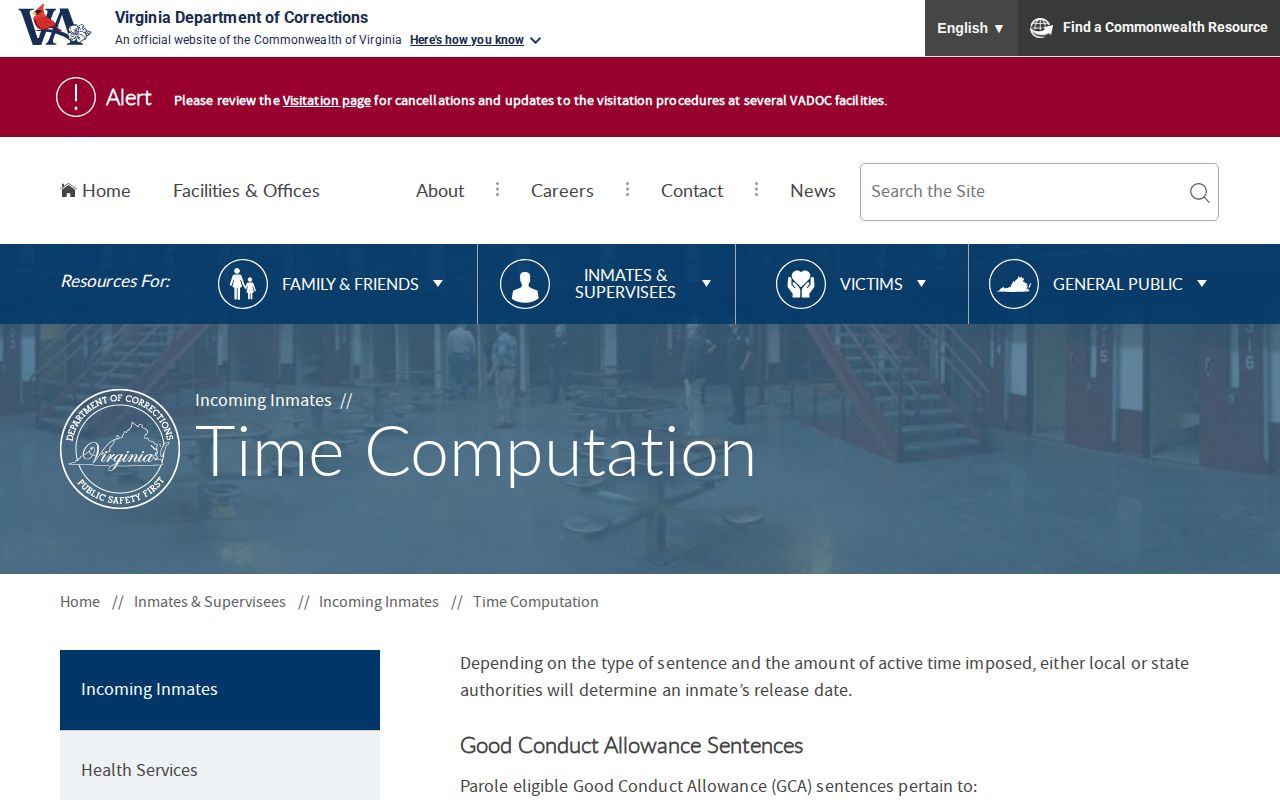
Inputs include jail time before VADOC, the type and total of each sentence, concurrent or consecutive structure, credit class, disciplinary events, and later orders. Concurrent terms run at the same time; consecutive terms run one after another. Jail credit is time the court and custodian recognize toward the sentence before state computation.
Code of Virginia § 53.1-202.2 establishes earned-credit eligibility for covered post-1994 felonies. One credit removes one day. Eligibility still depends on the full statutory framework and offense.
Virginia Credit Rates Affect Stafford
The familiar claim that every Virginia prisoner serves 85 percent is too broad. VADOC uses at-least-85-percent as a general explanation of truth in sentencing after ordinary parole was abolished for most post-1994 felonies. The classic maximum of 4.5 days of credit per 30 days served yields about that result. Current law, however, divides offenses and credit levels.
Under § 53.1-202.3, listed serious ESC-1 offenses allow no more than 4.5 days per 30 served. Other eligible ESC-2 offenses can earn 15 days per 30 at Level I, 7.5 at Level II, 3.5 at Level III, or none at Level IV. Conduct, program prerequisites, and offense restrictions apply. Credits may also be forfeited or restored under § 53.1-189.
The legislature has amended these provisions and official pages may display more than one effective version. Use the version that governed the offense and calculation. Do not estimate a release day from sentence length alone. The offense list, credit level, jail credit, and detainers are not known to a generic calculator.
Why Stafford Release Dates Change
A release projection changes when one of its inputs changes or another authority prevents the exit. Some changes alter the mathematical sentence balance. Others leave the calculated satisfaction date in place but block release to the community. That difference helps explain why two official records may show the same date but different custody outcomes.
| Factor | Effect on the date or exit |
|---|---|
| Credit class or conduct | Awarded, withheld, forfeited, or restored credits change the remaining term. |
| Jail-credit correction | Added or removed pretrial credit changes time left to serve. |
| Sentence structure | Concurrent, consecutive, or newly added terms change the calculation. |
| Amended court order | A judge may modify the controlling sentence or release authority. |
| Detainer or warrant | Another agency may take custody even when the Stafford or VADOC term ends. |
| Parole or conditional action | A grant, denial, revocation, or condition can change the release path. |
A detainer is a request or legal basis for another agency to hold or receive the person. It can produce a transfer rather than community release. Likewise, a parole grant is not an exact gate appointment. Planning, conditions, and another jurisdiction's hold may still intervene.
Stafford Local Release Timing
RRJ states that a time-served local inmate is released at 8:00 a.m. on the sentence-satisfaction date, even when it falls on a weekend or holiday. That rule is specific to RRJ local time-served releases. Bond releases follow a different process, and staff check VCIN and NCIC for detainers before release. A bond order therefore does not prove the person has left the jail.
VADOC uses a different state-institution rule. Its facility-release materials say discharge or parole release occurs by 11:59 p.m. on the release date, weather permitting. State staff may arrange an approved pickup or public transportation. Do not apply the RRJ morning rule to a VADOC institution, and do not apply the state rule to a county sentence ending at RRJ.
Note: Facility-specific timing matters because a valid release date can still involve hours of processing before the actual custody event is recorded.
Confirm Stafford’s Actual Release
VADOC's facility-release process adds direct proof. When the sentence is satisfied, the person is discharged or leaves on parole and receives a notification-of-release letter. Applicable papers can include an Order of Release, Conditions of Probation, or Conditions of Parole. Those papers are read, signed, and witnessed.
The official VADOC facility-release capture shows the state documentation that follows a completed Stafford-related prison term.
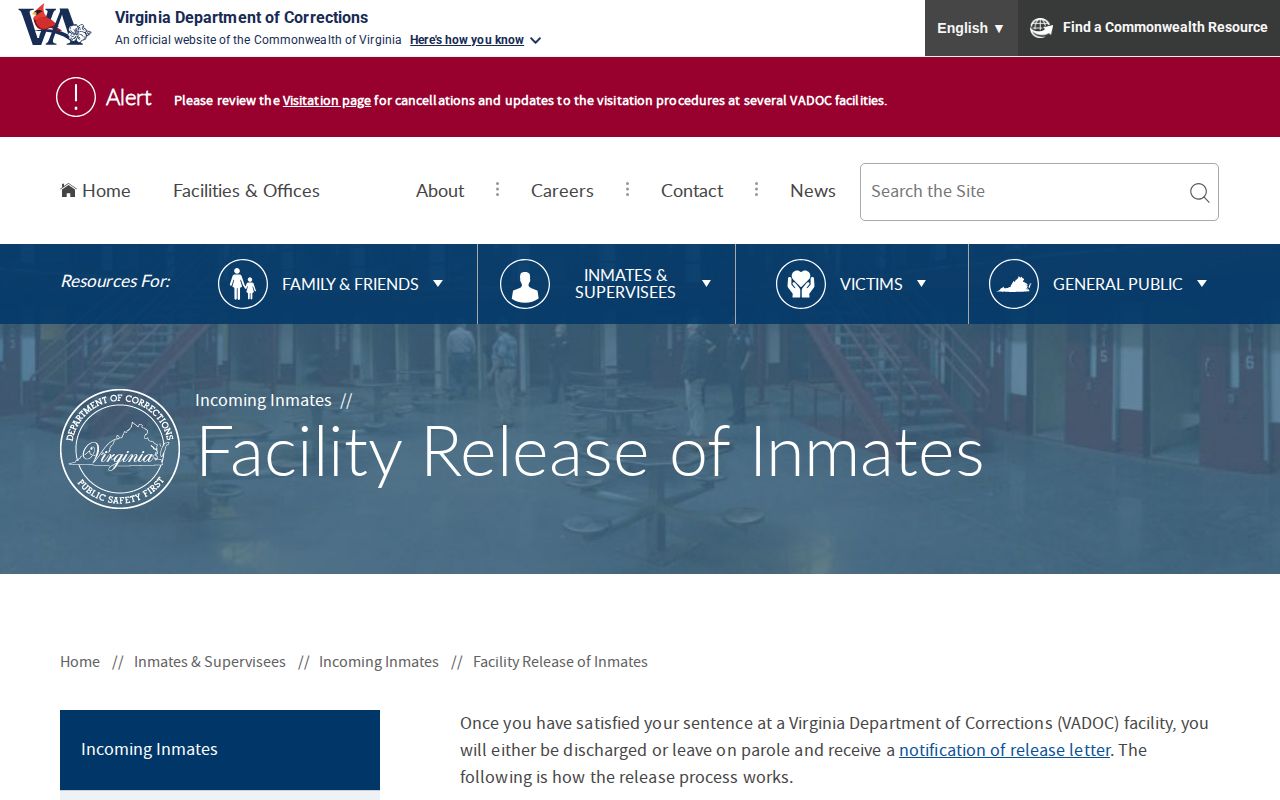
A signed release letter or actual agency event is stronger than an earlier projection. For RRJ, ask Inmate Records for the completed release date and time, type or authority, and receiving agency if maintained. For a pending custody event, the VINELink Check can provide a local-jail notice, but VADOC post-sentence notices use NAAVI instead. A notification helps with timing; it is not a certified release record.
When the projected date and actual record disagree, compare the full sequence instead of choosing the earliest date. Review each signed sentencing order, the Legal Update Sheet, the current locator detail, and any later detainer or court action. A calculation may have been valid when issued and then changed. Ask the calculating agency to identify the current projected date and ask the custodian for the separate completed event.
For a fully discharged state prisoner who no longer appears in the locator, request the existing inactive-offender record from VADOC. Provide the DOC ID, full name, birth date, and approximate term. For a local sentence, send the request to RRJ Inmate Records because RRJ calculated and processed that release. The Stafford court clerk can supply the signed order but cannot substitute for the jail's actual exit entry.
The custody status on the day before a projected date also matters. A prison location means the person remains incarcerated. A community corrections office means confinement ended but state supervision continues. A transfer entry means custody moved. These distinctions prevent a future estimate, a past prison exit, and a final discharge from being treated as the same date.
Keep each source with its date of access. VADOC warns that locator information may be inaccurate or out of date even though it updates daily. An older saved result can show what the agency reported at that time, but the current custodian and later official papers control the latest status. When a legal deadline depends on release, obtain direct confirmation instead of relying on a portal alone.
VADOC release papers can also explain the status after the gate event. Conditions of Probation or Conditions of Parole show that prison custody ended while a community term began. A notification-of-release letter confirms the state event, but it does not erase a separate Stafford order or another agency hold. Read each document for the authority it represents.
RRJ records answer a different question. For a local term, request the actual release entry and the authority or destination kept in the jail system. For an aggregate state term, ask for the jail-credit handoff and Legal Update Sheet, then use VADOC for the calculation. Keeping both records avoids asking either agency to certify facts held by the other.