
Stafford 72-Hour Release Availability
The required local-source sweep found no official RRJ or Stafford County rolling 72-hour release URL. RRJ's official site links to JailTracker, yet its configuration shows current offenders only. Release-date filters and released status are suppressed. A person who left RRJ during the past three days may no longer appear there at all.
The lack of a feed changes the task. Rather than scan a list, identify the person or define an exact three-day range for an existing record request. Virginia VINE can provide a reported custody event for one person. RRJ can confirm or produce an existing jail record. Stafford court records can show the order, sentence, or disposition that authorized the change.
Check Stafford Three-Day Releases
Use the start and end date as fixed boundaries. Then keep each source in its proper role. The sequence below works for one named person and can also shape a narrow request for an existing date-range report.
- Search Virginia VINE for the person. Read the exact release, transfer, escape, return, or death event rather than treating all absences alike.
- Check the RRJ current roster to see whether the person is still publicly listed.
- Contact RRJ at 540-288-5245 and route a completed-event question to Inmate Records. Provide spelling, date of birth if appropriate, booking number, and the three calendar dates.
- Review every relevant Stafford court case. General District Court covers misdemeanors and felony preliminary stages, while Circuit Court handles felony trials, final sentencing, and appeals.
- Submit a written request for an existing release report or record if the event cannot be confirmed. Ask for electronic delivery and a cost estimate.
For events confined to the current day, the 24-Hour Release List page focuses on same-day processing and bond timing. A three-day inquiry should not be broadened without need because a focused range helps the custodian locate responsive material.
Stafford Three-Day Record Fields
There are no official three-day feed fields because no feed is published. An RRJ request can name fields supported by the jail's own description of its records and release work. Ask for existing data only, and recognize that an exemption or redaction may apply.
| Field | Why it matters across 72 hours |
|---|---|
| Full name and booking number | Prevents two similar names from being combined. |
| Admission date | Identifies the correct custody episode. |
| Release date and time | Places the event inside or outside the three-day window. |
| Release authority or type | Connects the exit to bond, sentence completion, or a court order. |
| Destination or receiving agency | Separates community release from a transfer. |
| Charge, court, and bond data | Links the custody record with Stafford case information. |
The current public roster has different fields. It offers name and identifier searches, gender, and an intake-date range, with photos enabled. Those fields describe people now displayed as offenders. They do not turn JailTracker into a released-record archive.
Stafford Weekend Release Checks
A three-day range is especially useful after a weekend. RRJ states that a locally sentenced person who has served the required time is released at 8:00 a.m. on the sentence-satisfaction date, even on weekends and holidays. Bonding is also available seven days a week. Those facts show that releases do not pause just because regular business offices are closed.
Bond cases do not follow one fixed gate time. Cash, property, and bondsman routes require different papers. RRJ also checks VCIN and NCIC for detainers. A court action late in the week may therefore lead to a later completed event, another-agency transfer, or continued custody under a separate hold.
RRJ's departments overview identifies Intake, Inmate Records, Property, and community programs involved in custody and release work.

The official department map helps route a three-day question to the unit that keeps the record instead of treating every issue as a roster search.
Note: Count calendar dates for the event window, but expect records-office responses to follow the office's business-day process.
Stafford Release Request Route
Virginia FOIA provides a request path for existing public records. It does not force RRJ to create a new list or run a custom query that the jail does not maintain. Describe the record sought, give the exact dates, and ask the custodian whether an existing release log or report covers that span. Under Code of Virginia § 2.2-3704, the usual response period is five working days, subject to the statute's permitted responses and extensions.
Fees may reflect actual, reasonable access, duplication, supply, and search costs. Ask for an estimate before work begins and request electronic copies when practical. Virginia's statutory access class includes Virginia citizens and qualifying Virginia media, and the custodian may ask for a name and legal address.
When the inquiry concerns one person, VINE plus the RRJ event record is usually more direct than a date-range compilation. For a state sentence, use the VADOC Inmate and Supervisee Locator. Federal cases require BOP or U.S. Marshals channels, and a suspected immigration handoff requires ICE's locator.
The Stafford court search adds legal context. A dismissal, acquittal, bond order, or time-served sentence may explain why one charge no longer supports custody. It does not prove that every hold ended. Search each matching case and obtain the signed order from the clerk when the online summary is unclear. Juvenile and Domestic Relations records carry confidentiality limits, so an absent public result in that court cannot be used as proof.
Why Stafford Records Stay Hidden
RRJ's machine-readable roster configuration includes a 400-day released-retention setting. The same configuration sets the public view to current offenders only. The retention value may guide the system behind the interface, but it does not give the public a 400-day history or a way to switch on released records.
The RRJ public configuration documents this current-only setup. Virginia's local release-notification law provides the source shown below.
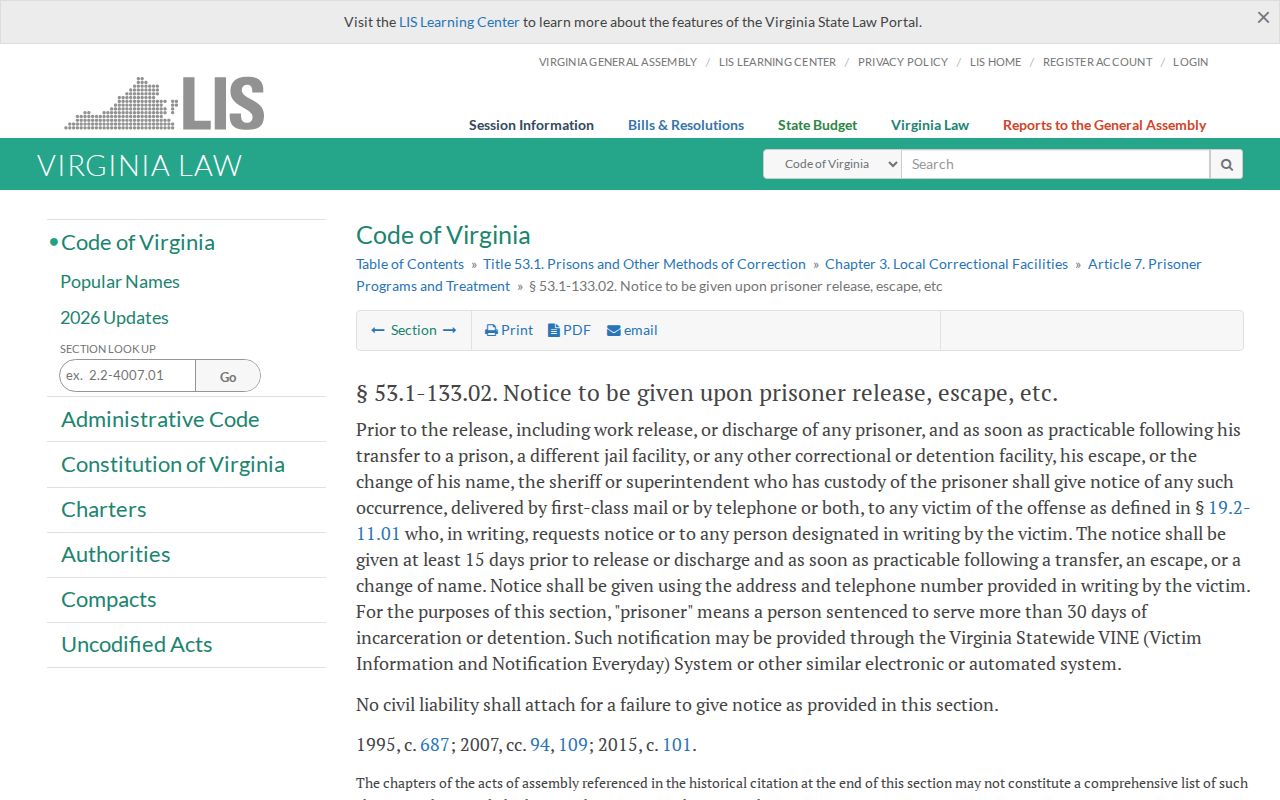
Virginia's release-notification framework supports event alerts, but it does not require RRJ to publish a rolling three-day list.
A saved screenshot of a current result still does not prove the later exit. The better record is an official release entry with its date, time, type, and destination. If the response says “transfer,” follow that custodian rather than calling it a community release.
VINE is event-driven and can help reconstruct the three days for one registered person. It is not a certified archive or a list of all releases. No official Stafford Sheriff mobile app advertising a recent-release view was verified. Mobile VINELink access supplies notices, not a sheriff feed with a known publication schedule.
Read Stafford Release Outcomes
A three-day search can cross several systems. The source label must control the conclusion. “Released” from RRJ means that local custody ended. A VADOC institution result means incarceration continues under state authority. A District 21 community-corrections location means the person is outside prison under supervision. An ICE result means civil immigration custody may follow the criminal-jail exit.
| Source result | Meaning | Limit |
|---|---|---|
| RRJ current record | Shown in present local custody | No past-release history |
| VINE release event | Local contributor reported departure | Not a certified jail extract |
| Court release order | Legal authority changed | Does not prove exact exit time |
| Receiving-agency record | Custody continued elsewhere | Not community release |
Use two consistent records when timing or destination matters. A court disposition can explain why the jail acted, while the RRJ record documents what happened in custody. That combination is stronger than a missing roster name.
For older events, online gaps become more common. RRJ has no visible historical roster, and VINE should not be treated as permanent storage. Ask for the jail record and court file. If the sentence entered VADOC authority, give VADOC the state number and approximate dates. A three-day range narrows the first search, but it does not change which agency owns the final answer.
A state number can appear before physical transfer from RRJ. For an aggregate sentence over 12 months, RRJ forwards jail credits to VADOC, which computes the sentence and issues a Legal Update Sheet with an estimated release date. That paper is not a completed release event. It helps identify the state record and route later checks to VADOC.
A person may also leave RRJ for another local jail, court movement, federal custody, or civil immigration detention. The receiving agency should appear in the existing record when documented. If a three-day request returns only a date, ask whether a release type or destination field is separately maintained and releasable. Avoid filling a gap with an assumption.
For a true community release, the event time and court authority should be consistent. For a transfer, the next system should show the continuing custody trail. That distinction is the core value of the wider window: it lets the requester compare several days without turning every disappearance into the same outcome.